
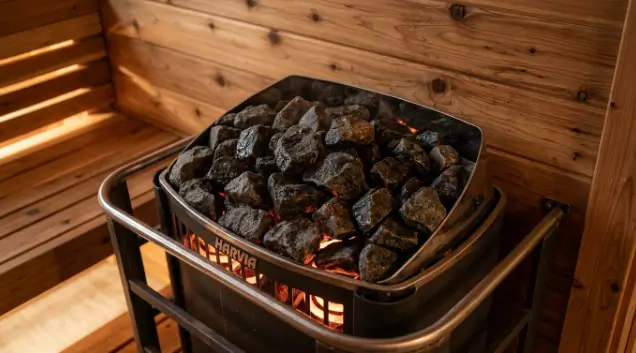
Contrast therapy pairs sauna heat with cold-water immersion in the same session, usually two to four rounds of 10 to 15 minutes of heat followed by 1 to 3 minutes of cold. A standard 6kW heater is enough for the sauna half of the pairing in most single or two-person setups, and the cold plunge needs its own 3 to 4 feet of clearance plus room for a chiller if it isn’t simply hose-filled. The research behind contrast therapy is real but limited, association rather than proof, and worth understanding honestly before building a routine around it.
1. Why Contrast Therapy Pairs Heat and Cold
The premise behind contrast therapy is that alternating vasodilation from heat with vasoconstriction from cold creates a pumping effect in blood flow that some people find helps with soreness and a feeling of alertness afterward. It’s a practice with a long history in Nordic and Scandinavian wellness culture, well before it became a talking point in fitness circles. The routine itself is simple: heat until genuinely warm, cold until genuinely cold, repeated a few times, with a short rest between rounds rather than jumping straight from one extreme to the other.
2. What Size Heater Supports a Contrast Routine
The heater sizing math for a contrast setup is identical to sizing a standalone sauna, since the cold plunge doesn’t add heating load to the cabin. A 6kW electric heater comfortably covers a single or two-person cabin in the 200 to 300 cubic foot range, the same range that works for someone using the sauna alone. What changes in a contrast setup is session pacing rather than heater output, since cycling the door open and closed between plunge rounds lets a bit more heat escape than a single uninterrupted session would.
3. How Much Space Does a Plunge and Heater Combo Need?
Beyond the cabin’s own footprint, a cold plunge tub typically needs another 3 to 4 feet of clear space for stepping in and out safely, plus room for a chiller unit if the plunge uses refrigeration rather than ice or a garden hose refill. Positioning the plunge within a few steps of the cabin door matters more than the exact square footage available, since the whole point of contrast therapy is moving quickly between hot and cold without a long walk in between. A covered or shaded spot for the plunge also helps keep water temperature more consistent between sessions.
4. What a Typical Contrast Session Looks Like
A common pattern is two to four rounds, each starting with 10 to 15 minutes of heat followed by 1 to 3 minutes of cold immersion, with a short seated rest of a few minutes between rounds rather than moving straight from the plunge back into the heat. First-timers generally start with shorter cold exposure, closer to 30 to 60 seconds, and build up gradually rather than attempting a full 3-minute plunge on the first try. Ending on a warm round rather than a cold one is a common preference, though there’s no hard rule.
5. What the Cardiovascular Research Shows
The cardiovascular research on sauna bathing itself is fairly well established at the population level. A large Finnish cohort study found men who used a sauna four to seven times weekly had lower rates of fatal cardiovascular events and all-cause mortality compared with men who used one once weekly, an association that held after adjusting for other risk factors. A follow-up study looked at the joint associations of sauna bathing and cardiorespiratory fitness on cardiovascular and all-cause mortality risk, finding both factors mattered independently. A separate study measured short-term effects of sauna bathing on blood-based markers of cardiovascular function in regular sauna users. The cold-immersion side of the pairing is less settled: cold-water immersion may ease some soreness markers, but evidence also suggests it can blunt strength and hypertrophy adaptations when used immediately after resistance training, so contrast therapy is best understood as association-level evidence for recovery comfort, not a proven performance enhancer.
6. How to Ease Into a Contrast Routine Safely
Anyone new to contrast therapy should build up gradually rather than attempting the full pattern on day one. A reasonable starting point is one round of heat followed by a short 30-second cold exposure, adding a second round only once the first feels manageable rather than shocking. People with a heart condition, high blood pressure that isn’t well controlled, or who are pregnant should talk with a doctor before starting a contrast routine, since moving between temperature extremes places more demand on the cardiovascular system than either heat or cold alone. Skipping the cold plunge on a day when feeling unwell or unusually fatigued, and simply doing a standalone sauna session instead, is a reasonable adjustment rather than pushing through the full routine out of habit. Keeping a towel and a warm layer within reach of the plunge also matters more than it sounds, since stepping out of cold water into open air on a chilly evening can feel far colder than the water itself, and having something to wrap up in immediately makes the transition back toward the cabin far more comfortable.
Buyers pricing out a heater for a contrast setup should compare coverage and clearance specs the same way they would for a standalone sauna. For a compact 6kW package sized to a single or two-person cabin, the model specs are listed at sweatdecks.com, useful for confirming clearance before placing a plunge just a few steps from the cabin door.
Frequently Asked Questions
What is contrast therapy with a sauna and cold plunge? Contrast therapy alternates hot sauna heat with cold-water immersion in the same session, typically several rounds of 10 to 15 minutes of heat followed by 1 to 3 minutes of cold.
What size heater works for a contrast therapy setup? A 6kW electric heater is enough for most single or two-person cabins used in a contrast routine, the same sizing math as a standalone sauna.
How much space does a sauna and cold plunge combo need? A cold plunge typically needs another 3 to 4 feet of clearance for entry and exit, plus room for a chiller if it isn’t simply refilled with ice or a hose.
Is cold plunging after a sauna proven to speed recovery? The evidence is mixed. Cold-water immersion may ease some soreness markers but may blunt strength and muscle-building adaptations after resistance training. It is association-level evidence, not a proven guarantee.
References
- Association between sauna bathing and fatal cardiovascular and all-cause mortality events, JAMA Internal Medicine, 2015
- Joint associations of sauna bathing and cardiorespiratory fitness on cardiovascular and all-cause mortality risk: a long-term prospective cohort study, Annals of Medicine, 2018
- Short-term effects of Finnish sauna bathing on blood-based markers of cardiovascular function in non-naive sauna users, Heart and Vessels, 2018
By Marcus Delgado

